
In late April a mid-sized fashion brand, for the obvious reasons unnamed here, signed off on its autumn season lookbook without booking a single studio day. The clothes existed. The models did not. Every editorial frame, every PDP shot, every social cut-down was generated. The brand's chief marketing officer described the process, with a slight wonder, as "the first time we shipped a season without firing anyone."
Synthetic on-model imagery — clothing draped on AI-generated bodies, in AI-generated rooms, lit by AI-generated photographers — crossed the production-ready threshold this season. The technology was not ready in autumn 2025. It was demonstrably not ready in spring 2026. It is ready now. The brands that adopt it first will compress their production calendar by a factor of ten. The brands that adopt it last will discover that the discipline of fashion marketing has changed underneath them, and the briefs they used to write no longer apply.
What synthetic models can do today
The current state of the art produces editorial-grade on-model imagery on three conditions. The clothing must be a real, photographed garment — the system cannot invent a new garment from a brief, and it would not be useful if it could. The body must be specified along controllable axes: pose, build, age, ethnicity, hair, expression and angle. The environment must be controllable too: backdrop, light, lens choice, mood.
- Fit and drape on a clothed model match a hand-shot reference at a confidence rate sufficient for ecommerce PDP use
- Pose, body and styling can be re-rendered per audience without re-shooting the garment
- Editorial and lifestyle frames are produced from the same primary asset that produces the PDP
- Multi-look composition — six outfits, one model, three environments — runs as a batch job rather than a shoot
- Right-to-use stays with the brand because the underlying model is synthetic
What they cannot do today
The technology is not magic. There are categories of imagery the current pipelines do not produce convincingly: macro detail on extreme fabrics with translucency, certain types of motion blur, complex hands holding the garment, certain hair textures under certain lighting conditions. Brands that try to do everything with synthetic imagery in 2026 will produce work that occasionally fails the believability test, and the failure is brand-damaging.
The competent operating model is a hybrid. A small photographic capture session for the highest-stakes assets — the brand campaign, the catwalk frames, the texture macros — and synthetic generation for everything downstream. The economics tilt heavily toward the hybrid: the budget required to capture the upstream primary asset is a fraction of the budget required to capture a full season.
Solving model consistency
The single biggest unlock between last year's synthetic imagery and this year's is consistency. Through 2025, the practical limit on synthetic on-model work was that the same synthetic model could not be reliably held across a campaign. A model that worked beautifully in frame one would drift across frames two and three. The face would settle into a slightly different face. The body would re-proportion. The hair would behave differently under the next lighting setup. For ecommerce PDP work — a hero shot, a three-quarter, a detail — the inconsistency was a deal-breaker. For a season lookbook with twenty looks and four environments, it was outright unusable.
Consistency was the discipline's hardest problem and the one that closed the most doors. It is now substantively solved. The 2026 generation of models can be locked, named and held across hundreds of frames inside a single campaign, across multiple lighting conditions, across varied poses, and — increasingly — across seasons. A brand can choose its synthetic cast in February, render the spring campaign with it, and bring the same characters back for the autumn season without the audience noticing they were never real in the first place.
- Identity persistence across a full season's render volume, not just inside a single frame batch
- Lighting-independent fidelity — the same face under studio light, dusk, harsh sun and overcast
- Pose stability — the same body proportions whether the model is standing, seated or walking
- Cross-shoot continuity — a casting decision made in spring binds the autumn render run without re-training
The practical consequence is that the casting decision now has the weight of a real-world casting decision. The brand that chooses a synthetic cast is choosing the faces the audience will see for the next eighteen months. That is a brand decision, not a production decision. Most fashion teams are not yet structured to make it.
The casting brief is the new content brief
The most underrated change is what happens to the casting brief. Traditional fashion casting is constrained by what a brand can afford to fly into a studio in a given week. Synthetic casting is constrained only by what the brand chooses to brief. The brand can — and increasingly will — render the same season on twelve different body types, six different ethnicities, four different age brackets and three different cultural contexts, and serve each rendering to the audience for whom it resonates.
“Synthetic models do not make casting easier. They make casting the whole brief.”
The discipline of writing a casting brief that yields imagery the customer recognises as themselves is now the discipline of marketing imagery. There is no longer a cost reason to send out one set of imagery to every audience. There is, however, a brand reason to be deliberate. A poorly-briefed synthetic season can produce content that feels generic, that feels nowhere, that feels for no one in particular. This is the new failure mode of the lazy fashion brand.
Rights, releases and the dignity question
Synthetic models do not need releases the way human models do. The brands using them must still address the rights story. The synthetic body is the output of a training run; the question of whether the training data included real human likeness is now a procurement question every brand should ask its vendor. Brands that adopt synthetic imagery without due diligence are exposed to a class of claims the industry has not yet litigated, and the litigation is coming.
- Demand that your vendor disclose the provenance of the model that generates the body — what was trained on, with what licensing
- Ensure the synthetic likeness produced cannot be matched to a real, identifiable person
- Treat the synthetic asset as a brand asset, not a stock asset — retain the rights in writing
- Disclose, on the product page or in the brand handbook, that on-model imagery is AI-generated where the customer might reasonably expect a human
The lookbook that fits the audience, not the brand
The single most consequential consequence of synthetic on-model imagery is that the lookbook is no longer a one-size-fits-all artefact. The Sandton mall version of a value-retailer lookbook can — and probably should — feature different body types and different styling than the Camps Bay version. The men's-shop version can run with a different model age than the women's-shop version. None of this required synthetic. All of it required cost levels that no apparel brand could rationally hit. Synthetic collapses the cost. What remains is the will to brief well.
The operating discipline this demands looks more like media planning than fashion production. Audience segments need to be defined ahead of the season, briefs need to be written per segment, and the resulting imagery needs to be served by the same audience logic the brand already uses for paid media. The brands ready to operate this way are the brands whose marketing and ecommerce teams already report to the same chief. The brands that still have separate creative and performance teams will spend the year shipping a single set of synthetic imagery to every audience, which is the worst of both worlds.
The blueprint, with Persaic as the enabler
The theory of audience-targeted imagery is one thing. The operating discipline is another. Here is how the work flows when the pieces are in place.
The brand publishes one primary capture session — the editorial shoot, the catwalk frames, the texture macros — yielding the highest-stakes assets a real shoot is still best at. Persaic ingests the garments from this primary asset library and renders the rest of the season against fully synthetic models. The cast is chosen in advance and held to the campaign, the way a real model would be cast and held under a contract. The brand defines its audience cohorts inside its customer data platform — basket history, geography, frequency, life-stage — and writes a casting brief per cohort. Persaic renders a variant of the season per cohort: body type, age, styling cues and environment shifted to match the audience the brand wants to recognise. The same garments. A different audience.
- One primary shoot per season, captured conventionally
- Persaic generates n cohort-matched variants from the same garment library, with the synthetic cast held across all of them
- The variant set lives in a single asset library, tagged by cohort
- An activation layer — a retail media platform, a CDP-driven onsite engine, or the brand's own paid-media stack — routes each variant to its matching cohort across onsite, in-store, offsite and owned channels
- Closed-loop attribution back to the basket or the conversion is recorded against the variant that drove it, not the campaign as a whole
The same synthetic cast member, rendered five times below, into five different South African settings and five different outfits. Same face, same body, same Chantel. The brand makes one casting decision and then routes the audience-appropriate frame to the audience-appropriate placement.
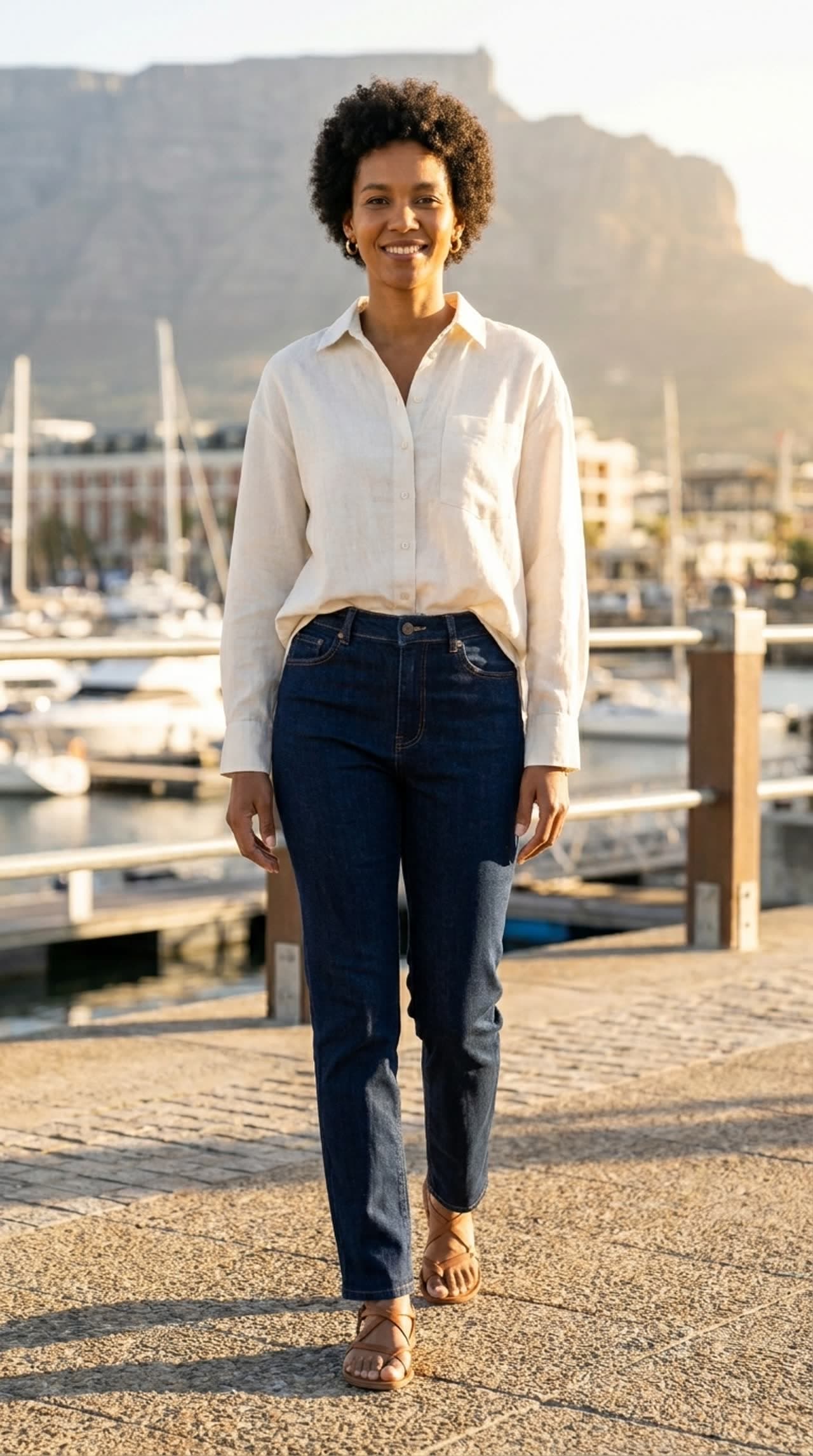

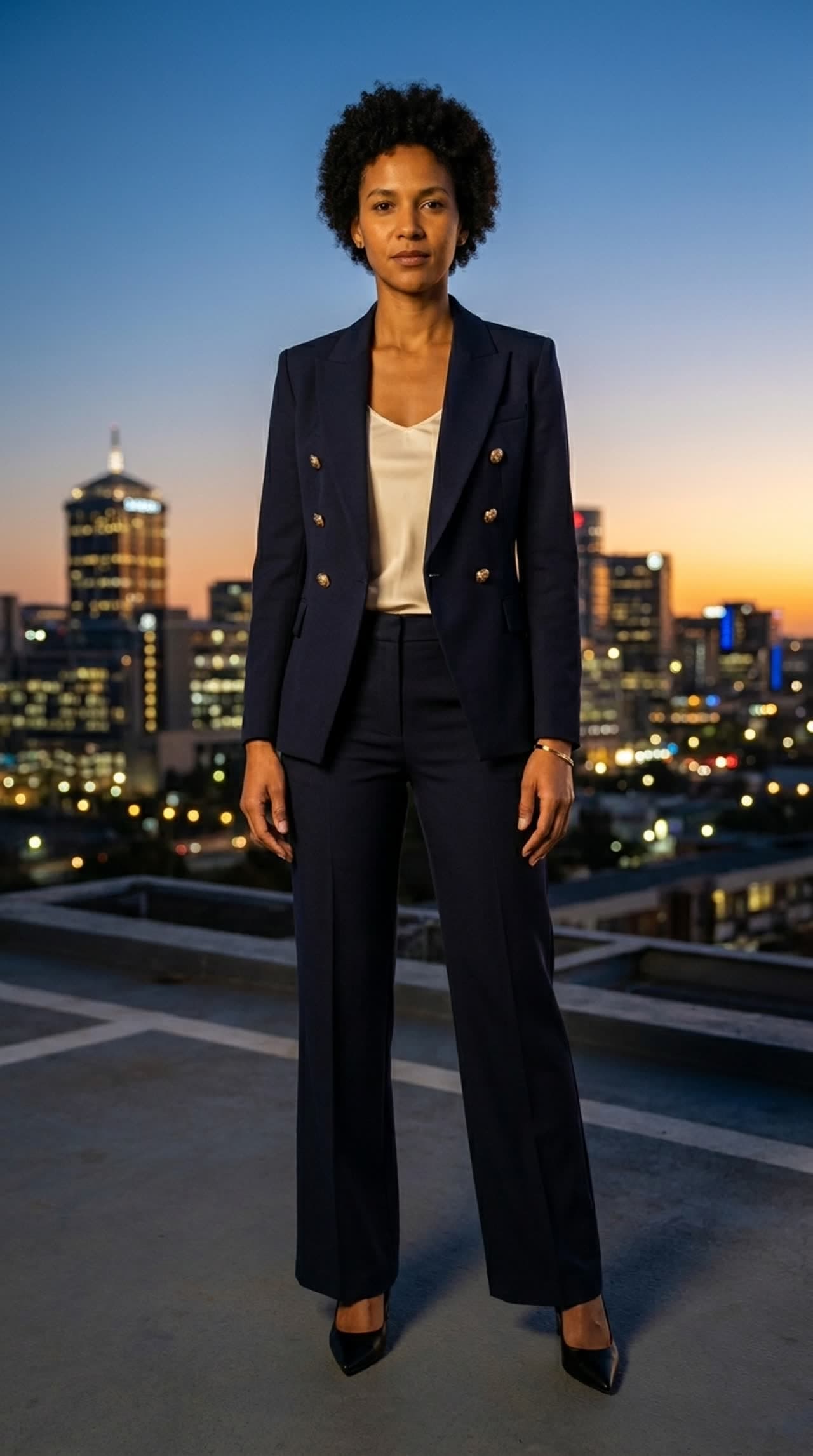

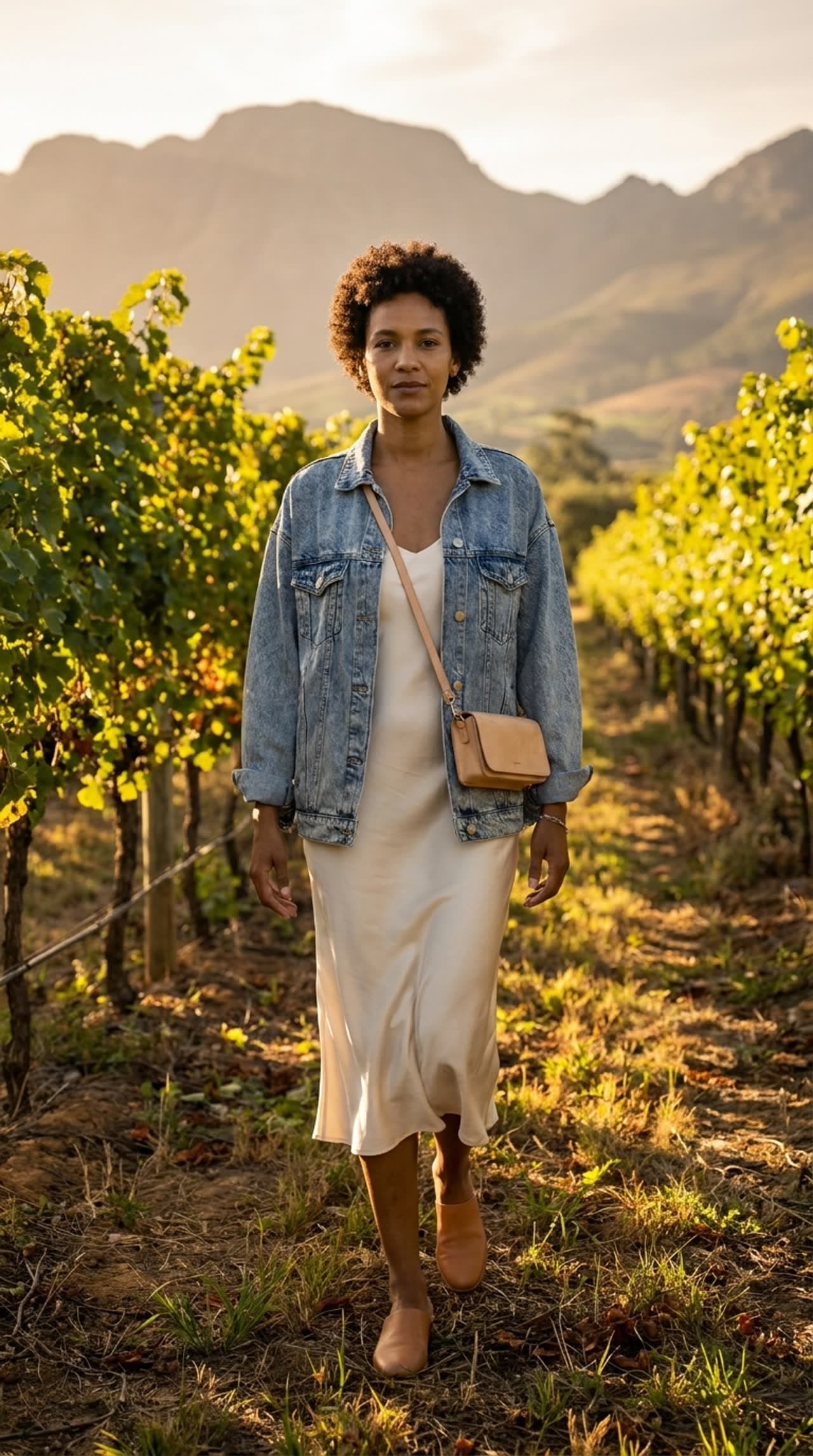
“The lookbook stops being a campaign asset and becomes a media inventory.”
The implication for the team is operational, not creative. The marketing function moves from briefing one season to briefing one season per cohort. The ecommerce function moves from owning a single set of PDP imagery to maintaining a library indexed by audience. The performance function moves from optimising creative against a campaign to optimising creative against the cohort that engaged with it. The teams that already report to the same chief will run this smoothly. The teams that do not will spend the first season learning why they should.
Operating model: in-house vs outsourced
The make-or-buy decision for synthetic imagery looks, for now, like the make-or-buy decision for any production capability. Small brands buy. Medium brands buy with retainer. Large brands build. The wrinkle is that the technology is moving fast enough that a build today is a maintenance liability in twelve months. The smart medium brands are signing one-year, renewable retainers with agencies that can operate the pipeline on their behalf, with the option to in-house in 2027 if the economics still warrant.
The brands that should not be doing this on the side of a desk, however, are clear. Any brand with more than 500 SKUs, any brand running more than two seasons a year, any brand whose product photography line item is in the millions. The economics of synthetic on-model imagery clear at the first SKU range and dominate by the third. The brands at scale that do not adopt by autumn 2027 will be running a cost structure their competitors are not.